

Digital Trade Commitments in US Tariff Deals
How tariff deals affect digital policy and differ from joint statements.
Authors
Tommaso Giardini, Nils Deeg
Published
02 Apr 2026

Note. This piece is part of our report on US Digital Trade Priorities.
All “tariff deals” negotiated by the US government contain the same digital trade commitments, contrasting the patchwork of commitments in joint statements.
The nine[1] deals signed to date include the same seven digital trade commitments, on digital services taxes, cross-border data flows, customs duties on electronic transmissions, a permanent WTO moratorium on such duties, non-discrimination, cybersecurity, and market entry conditions. The deals formulate these commitments in similar language. Only some deals add further commitments, for instance on online content and digital competition rules.
These commitments are more extensive and homogenous than the patchwork of commitments in joint statements. This suggests that, in final negotiations, the US government not only insists on the commitments in joint statements but secures additional commitments. Given the consistency of this pattern, we expect it to reoccur in upcoming negotiations, including with the six governments that have released joint statements mentioning digital commitments.
Figure 1: Digital trade commitments in deals and joint statements.[2]
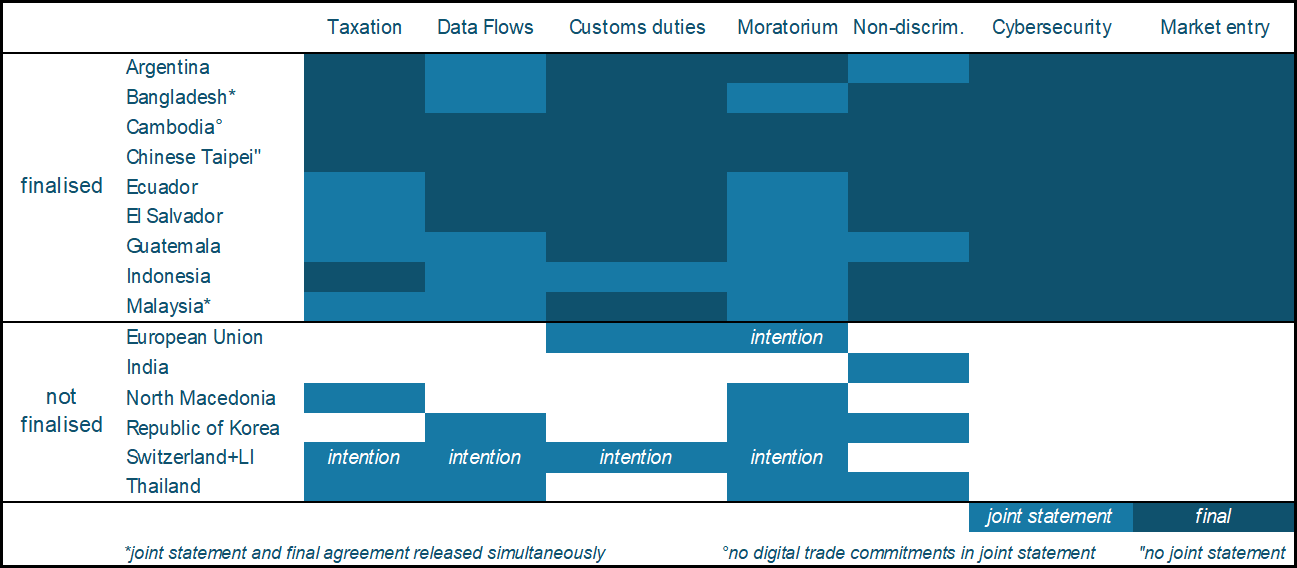
To guide negotiations, we explain the seven digital trade commitments included in all deals, outline additional commitments found only in single deals, and discuss implications for governments. Our findings are based on a novel, freely accessible tool that enables you to analyse and compare all available deals and joint statements, as listed in the Annex.
All Tariff Deals Include Seven Digital Trade Commitments
Tariff deals contain digital trade commitments in their main body, under “Digital Trade and Technology”, as well as in Annexes on specific commitments.
Commitments on digital services taxes are formulated in identical language: The counterpart shall not impose digital services taxes, or similar taxes, that discriminate against U.S. companies in law or in fact.
Commitments on data flows are consistent in their core but vary in their specificity. Bangladesh, Cambodia, Chinese Taipei, Ecuador, El Salvador, and Guatemala commit to ensuring the free transfer of data across trusted borders for the conduct of business. Malaysia and Indonesia commit to ensuring the cross-border transfer of data by electronic means across trusted borders, with appropriate protections, for the conduct of business.
Several deals include additional specific commitments in Annexes.
-
Bangladesh and El Salvador commit to recognise the Global Cross-Border Privacy Rules (CBPR) System and Global Privacy Recognition for Processors (PRP) System certifications as valid data transfer mechanisms. Ecuador endeavours to do so.
-
Guatemala, Ecuador, and Indonesia commit to providing certainty regarding the ability to move personal data out of its territory to the US. Guatemala commits to do so by recognising the US as a jurisdiction that provides adequate data protection. Ecuador endeavours to recognise the US such a jurisdiction by 31 December 2026. El Salvador also commits to recognising the US as such a jurisdiction, without referencing the certainty.
Argentina does not make a basic commitment to ensure cross-border data flows across trusted borders in the main body of its deal. Instead, the Annex states that Argentina shall provide certainty regarding the ability to move personal data out of its territory to the US, including by recognising the US as a jurisdiction with adequate data protection, and shall submit its letter of intent to participate as an Associate in the Global CBPR Forum and to participate in the Global Cooperation Arrangement for Privacy Enforcement.
Commitments on customs duties on electronic transmissions are identical: Counterparts shall not impose customs duties on electronic transmissions, including content transmitted electronically. Three deals provide additional detail:
-
Indonesia commits to eliminating its existing tariff lines on “intangible products” and suspending import declaration requirements for electronic transmissions.
-
The deals with Malaysia and Indonesia specify that this commitment does not preclude them from imposing internal taxes, fees, or other charges on electronic transmissions, including content transmitted electronically, provided that they are imposed in a manner consistent with the GATT and GATS.
-
The deal with El Salvador specifies that the commitment is in line with the existing requirements under the Dominican Republic-Central America FTA (CAFTA-DR).
Since 1998, a WTO moratorium prevents Members from imposing customs duties on electronic transmissions. Members have regularly renewed this moratorium during Ministerial Conferences, without ever making it permanent. Commitments on the WTO moratorium on customs duties on electronic transmissions are also identical: Counterparts commit to supporting the multilateral adoption of a permanent moratorium on customs duties at the WTO. For Argentina, Cambodia, and Indonesia, this commitment is explicitly immediate and unconditional.
After the WTO Members failed to prolong the moratorium at the 14th Ministerial Conference at the end of March 2026, the US Trade Representative stated his frustration and noted that “if the WTO cannot achieve this commonsense aim, the United States will work outside of the WTO with all interested partners to get it done.”
In commitments on non-discrimination, counterparts commit to refrain from discriminating against US digital services or products distributed digitally. The deal with Bangladesh uses the term “digital products” and does not cover “digital services”. Malaysia reserves the right to regulate in the public interest. Only the deal with Chinese Taipei affirms that no discriminatory measures are in place on the US side.
Cybersecurity commitments are identical and relatively unspecific: Counterparts commit to collaborating with the US to address cybersecurity challenges. Only the deal with Malaysia lists specific examples of possible collaborative activities, including exchanging information on threats and best practices, promoting the use of relevant international standards, and understanding capacity-building activities.
Finally, counterparts commit not to require US persons to transfer or provide access to a particular technology, production process, source code, or other proprietary knowledge as a condition for doing business in their territory. Counterparts also commit not to require US persons to purchase, utilize, or accord a preference to a particular technology. Only the deal with Chinese Taipei affirms that no such measures are in place on the US side.
These commitments are subject to exceptions. In all deals, the commitment does not preclude the ability of authorities to preserve and make available the source code of software, or an algorithm expressed in that source code, for the purposes of specific investigations or enforcement action. This exception is subject to safeguards against unauthorised disclosure. The deals with Bangladesh, Ecuador, Malaysia, and Argentina further specify that the commitment does not apply to government procurement. Bangladesh’s and Malaysia’s commitments also do not preclude the provision of source code as part of commercially negotiated contracts. Finally, Malaysia carves out software used for operating critical infrastructure, legal requirements to modify software source code, and measures adopted for prudential reasons.
Specific Deals Contain Further Commitments
In addition to the seven core digital trade commitments, several agreements contain additional, jurisdiction-specific commitments. These commitments either relate to domestic digital rules or to possible future digital trade agreements.
Commitments regarding domestic policies are established in Annexes and cover several topics:
-
Argentina commits to recognising electronic signatures created in the United States as valid under its law on electronic signatures, if they are supported by a digital certificate, reliably identify the signer, and ensure the integrity of the signed document.
-
Bangladesh commits to incorporating safeguards for freedom of expression in its Cyber Safety Ordinance 2025, to imposing stricter penalties for cybercrimes, and to opening part of the wireless spectrum frequency. It also commits to removing traceability requirements for end-to-end services and obligations to enclose encryption keys, by amending or repealing the 2021 Regulation for Digital, Social Media, and Over the Top Platforms. Finally, Bangladesh commits to increasing the use of stakeholder consultations in domestic policy-making, ensuring that US government and private sector feedback is considered in the revision of its Personal Data Protection Ordinance.
-
Cambodia agrees not to introduce a digital competition regime that unreasonably or unjustifiably restricts U.S. commerce.
-
Indonesia commits to refraining from requiring US digital service providers to support domestic news providers, including through paid licences, user data sharing, and profit sharing. Further, Indonesia will allow international payment networks provided by US companies to process domestic transactions on a cross-border basis and, especially in the financial sector, refrain from requiring data to be processed onshore, provided that Indonesian authorities have direct access to such information for supervisory and enforcement purposes.
-
Malaysia commits to repealing a directive requiring redirection of DNS traffic to local DNS services and to lift broadcasting restrictions on foreign programming and a requirement for large US social media providers to contribute 6% of Malaysian revenue to its Universal Service Provision Fund.
Six agreements further include institutional provisions regarding future digital trade agreements with third parties. Malaysia and Cambodia must consult with the United States “before entering into a new digital trade agreement with another country that jeopardizes essential U.S. interests”, while Indonesia must communicate with the US before doing so. The US may terminate its agreements with Bangladesh, Guatemala and Chinese Taipei if they enter into digital trade agreements with certain countries.
The Two Layers of US Digital Trade Priorities
Digital trade commitments in tariff deals reveal two layers of the US government’s digital trade priorities: On the bilateral layer, the US pursues a consistent pattern of commitments with all trading partners, without flexibility. On the global layer, these commitments contain a signal towards both China and the European Union.
The bilateral layer shows how the US is using transactional tariff deal negotiations to extract unilateral digital trade commitments from counterparts. These commitments are consistent, despite substantial differences between earlier joint statements, especially for Argentina, El Salvador and Guatemala. The only differences between the final deals relate to additional jurisdiction-specific commitments. The US has always insisted on its core demands. We expect this strategy to continue in negotiations with other governments, including the six jurisdictions whose joint statements contain digital trade commitments: the European Union, India, the Republic of Korea, North Macedonia, Switzerland and Liechtenstein, and Thailand. Notably, some of these jurisdictions have larger digital trade volumes compared to the jurisdiction with finalised deals, which they may be able to leverage and achieve a different negotiation outcome.
Beyond the bilateral layer, the US is attempting to reduce the influence of China and the European Union in digital policy through these digital trade commitments. The institutional provisions, requiring prior consultation with the US before and allowing the US to terminate agreements if counterparts enter into digital trade agreements with third parties, are seemingly motivated by strategic competition considerations regarding China: Such “poison pills“ significantly complicate governments’ hedging strategies. In addition, the US is aiming to contain the proliferation of domestic digital policy developments worldwide, which is often spearheaded by the European Union, for instance through the General Data Protection Regulation, Digital Services Act, Digital Markets Act, and Artificial Intelligence Act. But the US pressure to counter domestic digital policies is already yielding results, and we expect Section 301 investigations to continue this chilling effect.
Note on the Scope of Analysis
Since the Supreme Court ruling invalidating tariffs under the International Emergency Economic Powers Act, the future legal validity of these deals is in question. Some governments have continued the implementation process, others not. The USTR, in its annual National Trade Estimates report, considers the deals valid. Our goal is to understand the US government’s digital trade agenda, for which the deals provide valuable insight. To this end, our analysis is based on bilateral documents, issued by the US and counterparts, that contain specific digital trade commitments.
Both the White House and the United States Trade Representative (USTR) unilaterally issue fact sheets to accompany the release of joint statements and deals. We do not include these documents in the analysis because they contain information that can be inconsistent with the counterpart’s position:
-
A White House fact sheet on the India-US deal initially stated that India would “remove its digital services taxes and committed to negotiate a robust set of bilateral digital trade rules that address discriminatory or burdensome practices and other barriers to digital trade, including rules that prohibit the imposition of customs duties on electronic transmissions.” The reference to DSTs and customs duties has since been removed from the fact sheet, bringing its wording on digital trade in line with the joint statement.
-
The USTR fact sheet on the Argentina-US framework mentioned commitments regarding DSTs and customs duties, which were not included in the joint statement (but were finally included in the deal).
-
The USTR fact sheet on the US-Viet Nam framework stated that Viet Nam had committed to refraining from imposing customs duties on electronic transmissions, and affirmed that it did not require licenses for cross-border data transfers out of its territory. The joint statement only stated that the countries would finalise digital trade commitments.
Several other types of policy documents comprise the tariff deal spectrum. The US has reached technology prosperity deals with Korea, Japan, and the United Kingdom, as well as trade and investment deals with Korea and Japan. Since these deals do not contain specific digital trade commitments, they are not covered in the analysis. The same applies to the General Terms of the Economic Prosperity Deal between the US and the United Kingdom, which states in broad terms that the countries will negotiate an “ambitious set of digital trade provisions” and the US-Viet Nam joint statement, which announces that the parties will “finalize commitments on digital trade.”
Our Tool to Analyse Tariff Deals
To support in-depth analysis, the Digital Policy Alert provides a free tool to investigate the full text of these documents. Readers can:
-
Navigate our library of tariff deals and joint statements;
-
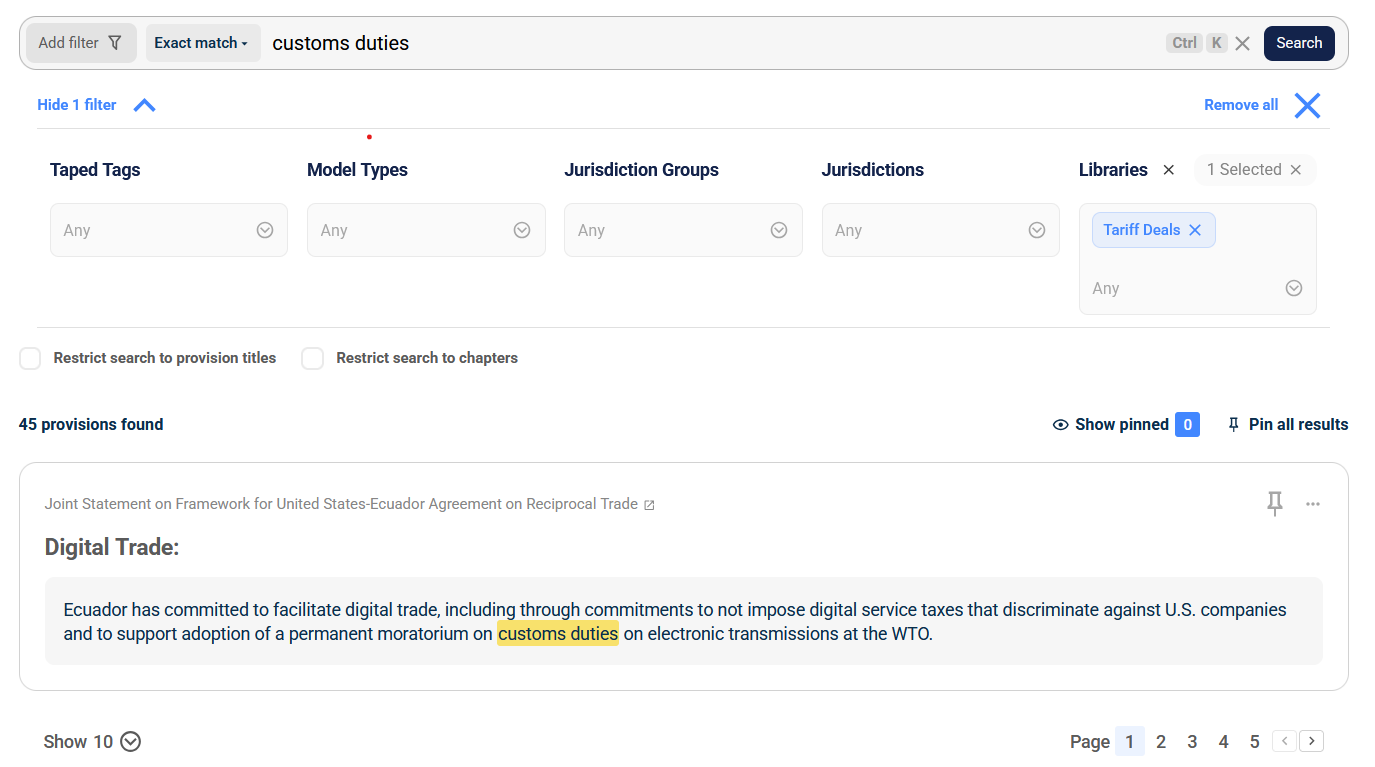
Search for relevant provisions across all documents;
-
Chat with different documents using our AI system that provides detailed references;
-
Explore the full text text of any document; and
-
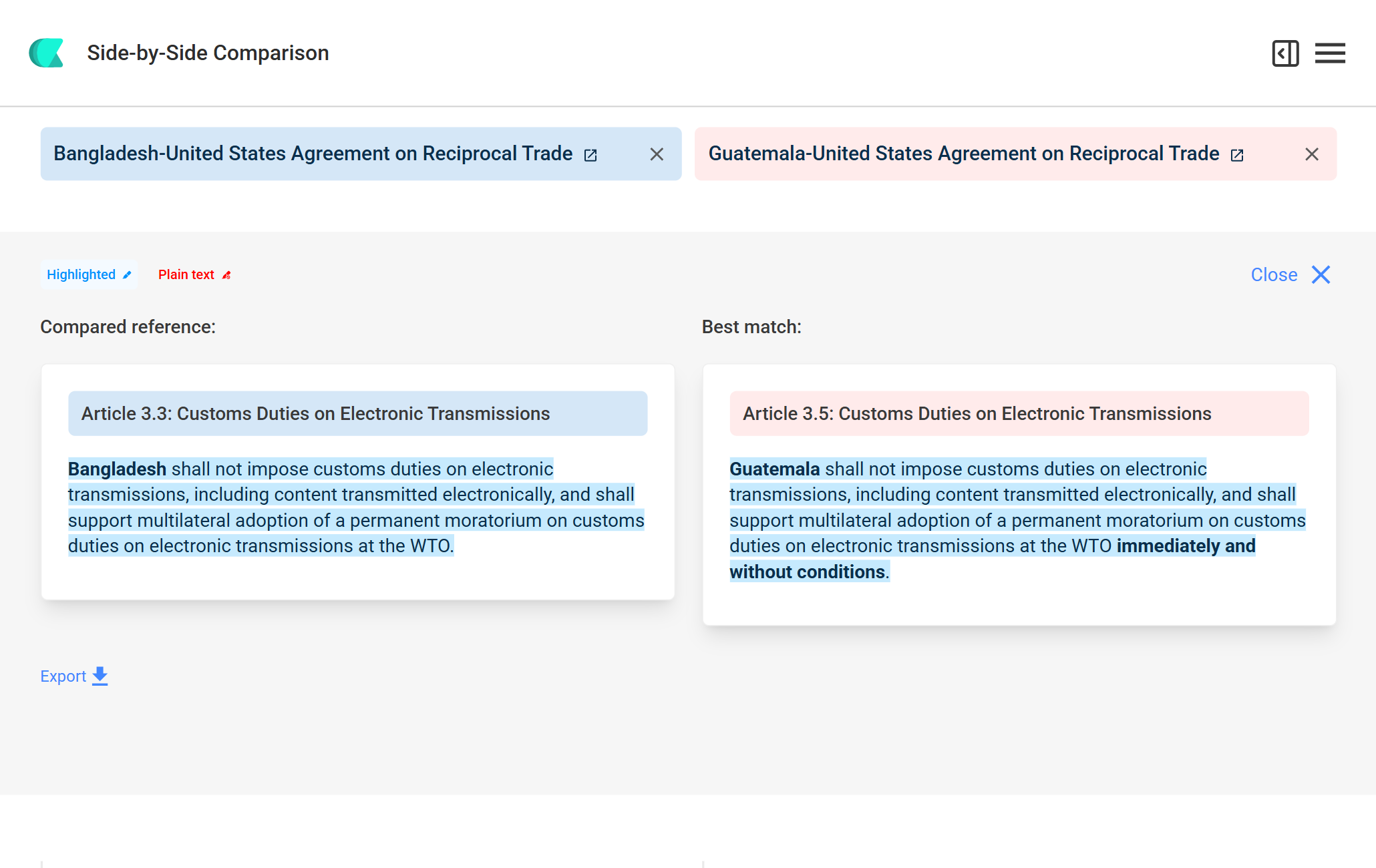
Compare documents side-by-side, for example the deals with Indonesia and Ecuador.
Contact us for a quick call to discuss how this tool can support your work.
Example 1: The Comparator visualises similarities and differences.
Example 2: The Provision Explorer finds relevant passages across all documents.
Annex: Links to Relevant Documents
This Annex bundles and links to full text of the reciprocal trade agreements and framework joint statements used in this analysis.
Reciprocal trade agreements:
Argentina: Agreement / Joint Statement
Bangladesh: Agreement / Joint Statement
Cambodia: Agreement / Joint Statement
Chinese Taipei: Agreement
Ecuador: Agreement / Joint Statement
El Salvador: Agreement / Joint Statement
Guatemala: Agreement / Joint Statement
Indonesia: Agreement / Joint Statement
Malaysia: Agreement / Joint Statement
Joint Statements:
European Union: Joint Statement
India: Joint Statement
North Macedonia: Joint Statement
Republic of Korea: Joint Fact Sheet
Switzerland and Liechtenstein: Joint Statement
Thailand: Joint Statement
Specifically, we refer to deals with Malaysia and Cambodia (October 2025), El Salvador and Guatemala (January 2026), Argentina, Bangladesh, Chinese Taipei, and Indonesia (February 2026), and Ecuador (March 2026). Note that the agreement with Chinese Taipei is between the American Institute in Taiwan and the Taipei Economic and Cultural Representative Office in the US.
The table includes documents based on two criteria: Documents must be issued jointly and must include specific digital trade commitments. See the note on the scope of our analysis at the end of this document for further details.