

Digital Policy in the US Trade Representative’s 2026 National Trade Estimates Report
How the NTE covers digital policy and aligns with the US government's digital trade actions.
Authors
Tommaso Giardini, Nils Deeg
Published
02 Apr 2026

Note. This roundup is part of our report on US Digital Trade Priorities.
The US Trade Representative's 2026 National Trade Estimates (NTE) report identifies 146 digital policies across 43 jurisdictions as significant foreign trade barriers. The covered digital policy areas and jurisdictions appear consistent with previous US digital trade priorities, but contain substantial gaps on artificial intelligence and competition. This analysis outlines the NTE’s coverage of digital policies, interprets its shift from the US government’s digital trade priorities, and discusses whether the NTE captures governments’ digital policy priorities. To support in-depth analysis, we provide readers with a free analytical tool and the dataset on which our findings are based.
The NTE, published on 31 March 2026, is a 534-page catalogue of foreign trade barriers. On digital trade, it covers seven[1] policy areas: data governance and cross-border data flows, local content promotion, online speech, digital taxation, cybersecurity, competition, and artificial intelligence.
Data governance and data flow policies dominate, with 58 entries. This reflects the US government's longstanding view that restrictions on cross-border data flows, especially data localisation mandates, represent market access barriers. Online speech rules follow, with 26 entries, for instance requirements for social media platforms to moderate certain content or restrict access for children, as well as internet shutdowns. The report identifies 25 local content promotion policies, primarily requirements for streaming providers to support local productions, through both quotas and investment obligations. Digital taxation measures, 10 in total, include taxes imposed specifically on digital service providers. Rules on cybersecurity and competition in digital markets appear 10 times each. Finally, the NTE refers to artificial intelligence rules only three times and identifies four policies that do not fit any of these categories, such as licensing requirements.
The NTE covers 63 jurisdictions in total and identifies digital trade barriers in 46 of them. It identifies the most digital trade barriers in Viet Nam (10), the Republic of Korea and the European Union (9), as well as China, India, and Turkey (8). Pakistan, Canada, and Russia also feature prominently. These jurisdictions are a mix of large trade blocs, including China and the EU, and smaller economies with fast-growing digital markets, such as the Republic of Korea and Viet Nam.
Several of these jurisdictions are at the centre of the US Trade Representative’s attention, as evidenced by the NTE’s word counts: The NTE devotes 32,189 words to China, 26,615 to the European Union, 10,432 to India, 8,903 to Russia, and 7,867 to Turkey. Two exceptions from this perspective are Indonesia and the Gulf Cooperation Council, with 12,000 words each but only few digital trade barriers.
To investigate whether the 2026 NTE aligns with the US government’s previous digital trade priorities, we analyse its overlap with the 2025 NTE and digital trade negotiations throughout 2025.
The discrimination of US technology companies was already a priority in the 2025 NTE, as shown in the Global Trade Alert’s analysis of the 2025 NTE. The emphasised digital policy areas, including restrictions on data flows and digital services taxes are similar, as are the jurisdictions, especially the focus on Viet Nam, China, and the EU.
In terms of negotiations, the US government pursued “tariff deals” with nine counterparts, consistently establishing seven digital trade commitments: digital services taxes, cross-border data flows, customs duties on electronic transmissions, a permanent WTO moratorium on such duties, non-discrimination, cybersecurity, and market entry conditions (source code disclosure). While several of these policy areas overlap with the NTE, the focus is different in two ways. First, online speech rules and local content promotion feature prominently in the NTE but are not often subject to tariff deal commitments. Second, customs duties on electronic transmissions and source code disclosure are included in the tariff deals but not in the NTE, with one exception in Indonesia. Presumably, tariff deals aim to counter such policies before they are imposed or even deliberated, and could thus be identified in the NTE.
In view of the US government’s rhetoric on digital policy throughout 2025, two further areas stand out: competition and artificial intelligence. The US government has vocally countered the EU's Digital Markets Act and the Republic of Korea’s deliberations on digital competition rules. The NTE, however, records only 9 digital competition entries. More remarkably, the US government has forcefully opposed the “excessive regulation” of artificial intelligence, including the “European model of fear and overregulation”. With only 3 entries on artificial intelligence, the NTE largely omits a core priority for governments worldwide.
We conclude by analysing whether the USTR captures domestic digital priorities worldwide, as documented by the Digital Policy Alert database. In the past year, our team has monitored over 5,400 policy and enforcement developments affecting the digital economy worldwide. In terms of policy areas, data governance was by far the most salient (1186), followed by consumer protection (665), and content moderation (453), design and testing standards that focus mostly on artificial intelligence (332), and competition (288). For jurisdictions, besides the US, the five most active were the EU (428), China (421), the United Kingdom (325), the Republic of Korea (218), and Brazil (207).
Three gaps between the NTE and the Digital Policy Alert database stand out. First, the NTE ignores consumer protection policies, which are increasing in frequency and will presumably continue to, especially as governments focus on protecting minors online. Second, the NTE does not emphasise competition and AI rules despite both being priorities for governments worldwide. In turn, the NTE focuses disproportionately on local content promotion. Third, the NTE does not capture the digital policy developments in the United Kingdom and Brazil to their full extent. In the United Kingdom, the NTE focuses mostly on the Digital Services Tax, which the US government unsuccessfully aimed to counter through tariff negotiations in 2025. In Brazil, the NTE does not mention previously alleged online “censorship”, which had led to temporary visa restrictions for a Brazilian judge in 2025.
The NTE thus provides useful insights into US priorities, although it diverges from both the US government’s negotiations and rhetoric, and global digital policy developments in the past year.
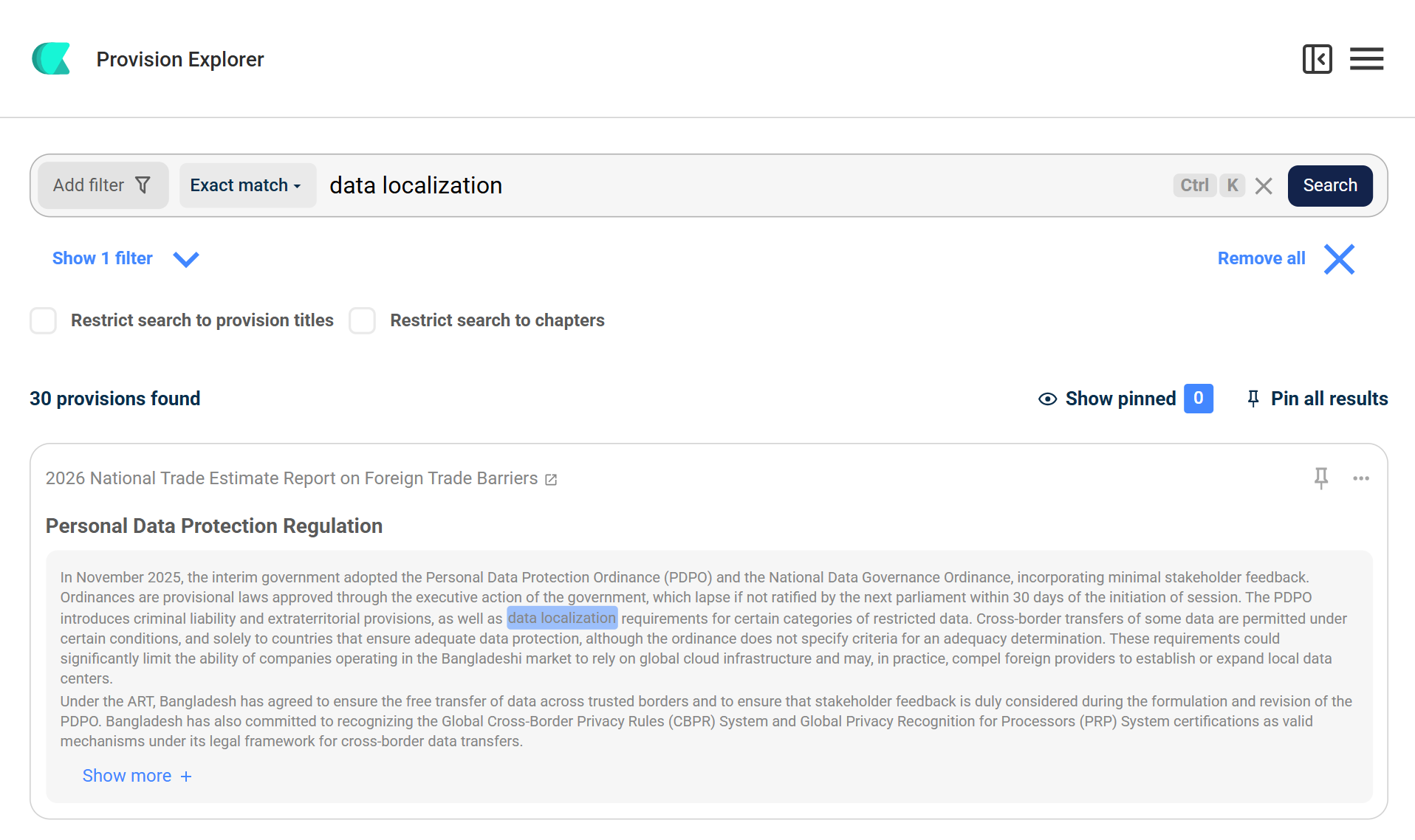
To support in-depth analysis, the Digital Policy Alert provides a free tool to investigate the full text of these documents. Readers can:
-
Navigate our library of tariff deals and joint statements;
-
Search for relevant provisions across all documents;
-
Chat with different documents using our AI system that provides detailed references;
-
Explore the full text text of any document; and
-
Compare documents side-by-side, for example the NTE of 2026 and 2025.
Contact us for a quick call to discuss how this tool can support your work.
Example: The Provision Explorer finds relevant passages across all documents.
We focus on policies that affect the digital economy specifically, not broader policies regarding telecommunications, intellectual property, financial services (including electronic payments), government procurement, and taxes (including value-added-taxes).