

The Final Brazil Section 301 Tariff Takes Effect on 22 July with Wider Exemptions
USTR's final Section 301 action on Brazil takes effect on 22 July. We estimate Brazil's effective US tariff rises from 11.0% to 17.5%, and stays near there: when the Section 122 surcharge lapses on 24 July, a new Section 301 tariff on forced labour takes its place. The 25% Brazil action adds 6.5 points, half a point below the June proposal.
Authors
Johannes Fritz
Published
16 Jul 2026
Brazil's effective US tariff rises to 17.5% and holds
On 15 July 2026 the US Trade Representative issued the final Section 301 action against Brazil: a 25% tariff on substantially all Brazilian goods, in force from 22 July. We estimate that Brazil's trade-weighted US tariff rises from 11.0% today to 17.5% on 22 July, and stays around 17.7% after 24 July. It does not fall back: a separate Section 301 tariff on forced labour takes effect on 24 July, the same day the Section 122 surcharge lapses, and roughly replaces it. The 25% Brazil action itself adds 6.5 points, half a point below the June proposal.
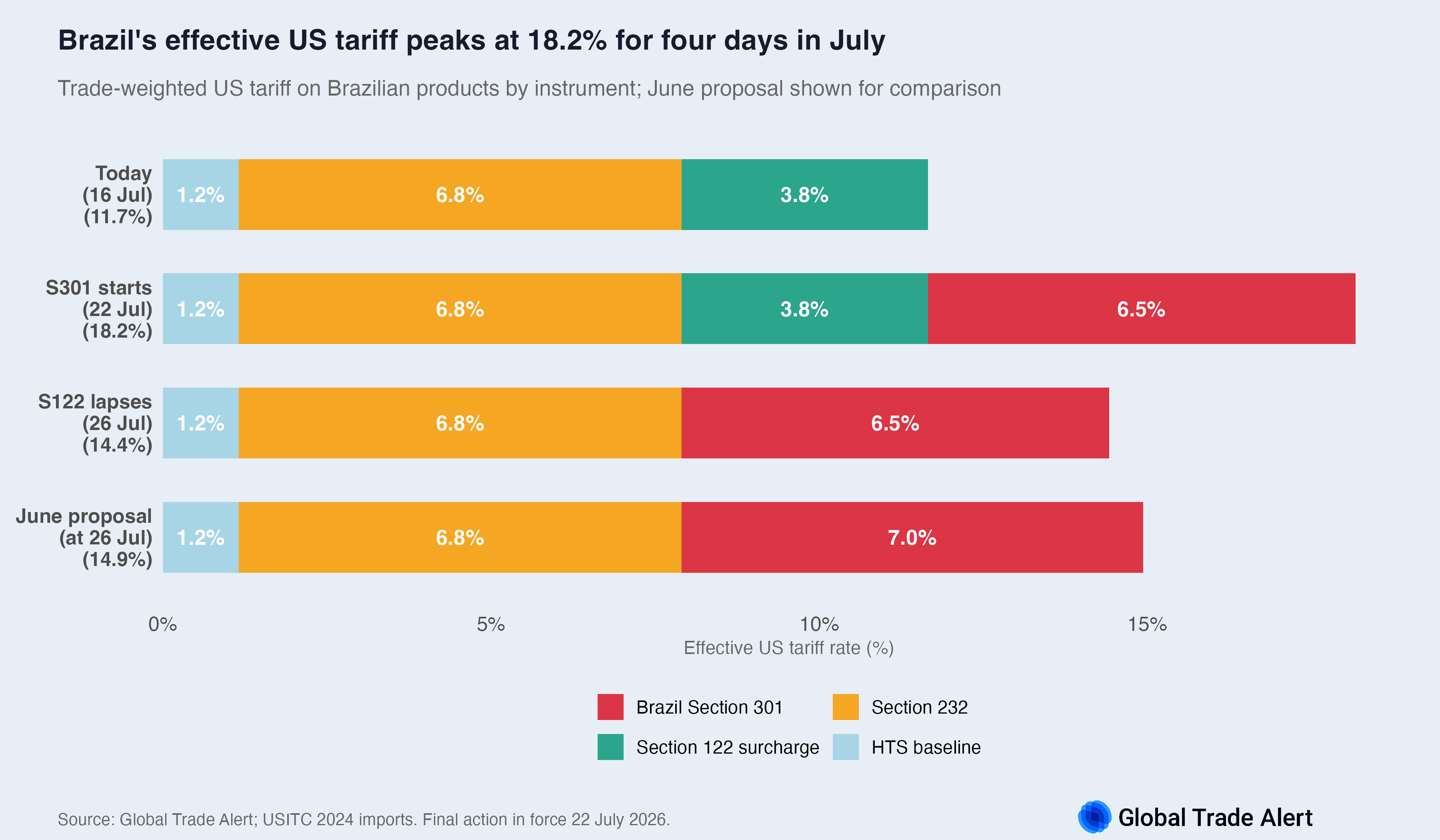
For two days, 22 and 23 July, the new Brazil Section 301 (6.5 percentage points on a trade-weighted basis, worth $2.6bn a year on 2024 imports) stacks on top of the 10% Section 122 surcharge, which contributes 3.1 points to Brazil's rate. From 24 July the surcharge lapses and the forced-labour Section 301 takes its place, adding 3.2 points, so Brazil's rate holds near 17.7% rather than falling back. Ordinary tariffs (1.2 points) and Section 232 (6.8 points) sit underneath throughout. Brazil's implied annual duty moves from $4.4bn today to about $7.0bn.
A fifth of US imports from Brazil pays the full 25%
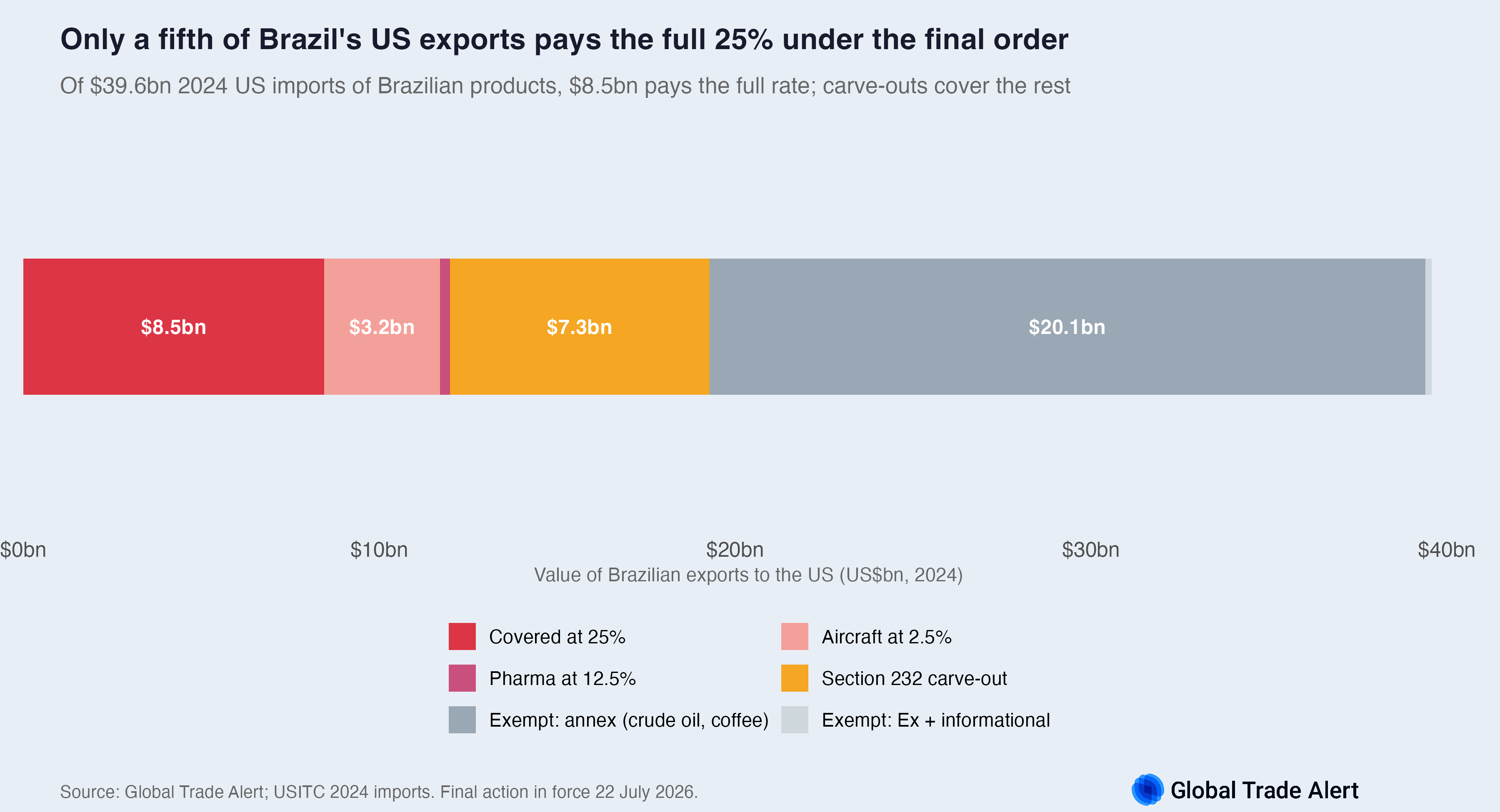
Like the June proposal, the final order is a negative list: 25% on everything, then exemptions. Of $39.6bn in 2024 US imports of Brazilian products, $8.5bn pays the full rate. The annex exemptions cover $20.1bn, led by crude oil and coffee. Goods under Section 232 account for a further $7.3bn, carved out of the Section 301 because they already pay the metal, lumber or vehicle tariffs. Aircraft lines worth $3.2bn pay an effective 2.5% under the civil-aircraft carve-out, and a new pharmaceutical-applications class worth $0.3bn pays an effective 12.5%.
The final order adds $2.4bn of exemptions and withdraws one
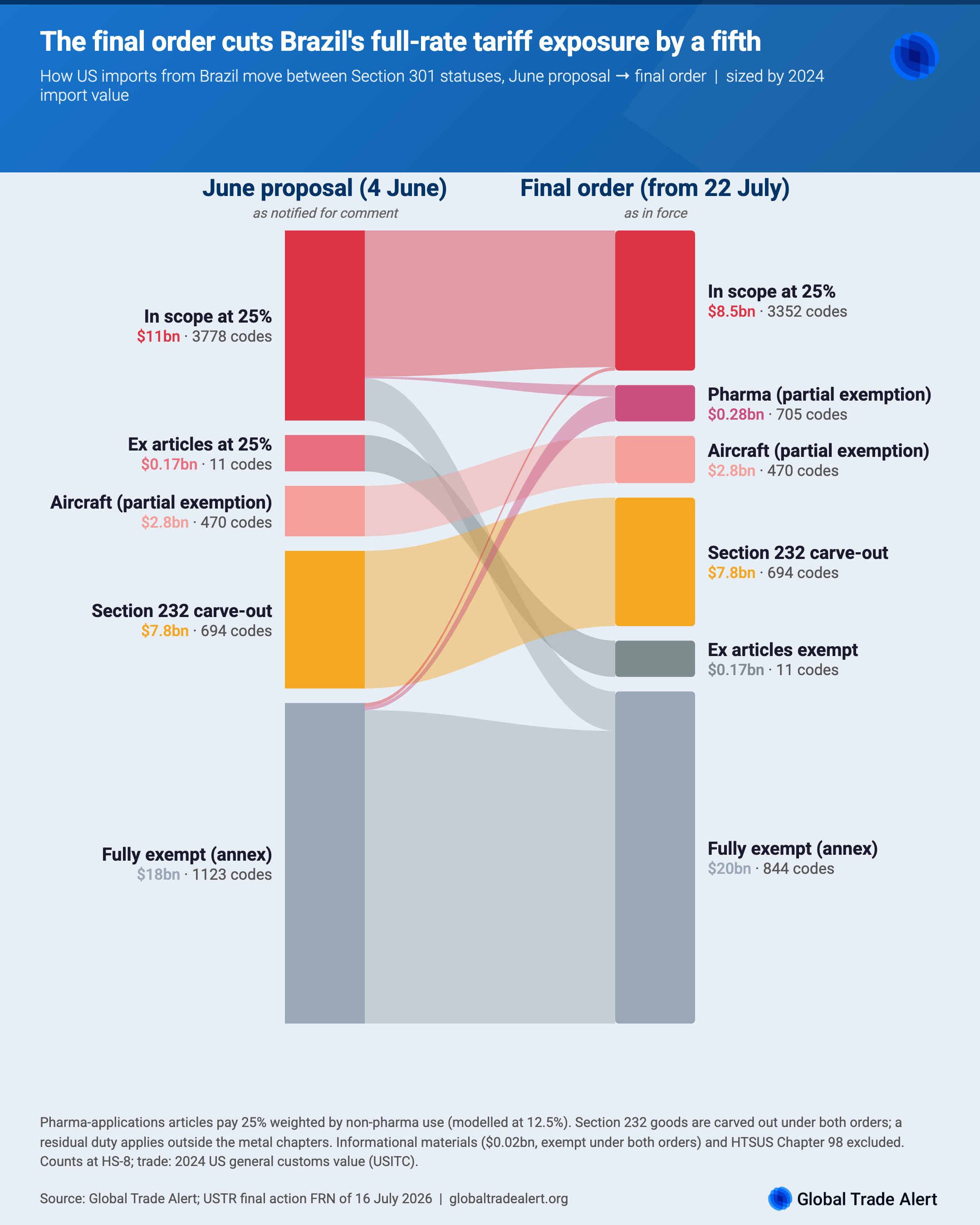
USTR received requests both to widen and to narrow the June exemption list. The final order widens it. Twelve product groups were added, moving 86 tariff lines with $2.4bn of Brazilian trade out of the 25%. USTR justified each addition under one of four tests: raw materials whose tariffing "could lead to the unavailability of domestic supply"; products that "could cause economy-wide disruptions"; products that "cannot be grown or produced in sufficient quantities or at reasonable prices in the United States or obtained from other sources"; and articles whose tariffing "may not contribute substantially" to eliminating the practices under investigation.
Ranked by import value, pig iron dominates the new exemptions ($1.5bn). USTR accepted arguments that US foundries depend on imports because integrated steel producers consume more than 95% of domestic output and Russia's war in Ukraine has curtailed supply from both belligerents. Unflavoured instant coffee ($0.17bn) follows: the June annex had exempted flavoured instant coffee only, and commenters argued there is "no rationale for treating flavored and unflavored instant coffee differently". Then come hand-executed paintings ($0.14bn), aluminium hydroxide ($0.12bn, where the sole US supplier cannot meet demand and Brazil supplies roughly 40% of the market), certified organic honey ($0.08bn, US production covers 3% of domestic demand) and frozen fish ($0.07bn). USTR exempted antiques and used clothing on different grounds, stating that goods not newly produced do little to change Brazilian conduct.
One product moved the other way. High-purity dissolving woodpulp ($0.21bn), exempt in June, now pays the full 25% after testimony alleged that Brazilian producers benefit from illegal deforestation and that the few downstream users have domestic alternatives.
The order tightens the pharmaceutical exemption and completes the "Ex" line exemptions. A new 705-line pharmaceutical class, including 364 lines that held unconditional exemptions in June, is now exempt only for pharmaceutical applications; USTR called an all-applications exemption "broader than necessary". The largest affected line is $50m of nitrogen-heterocycle compounds. The 11 "Ex" lines the proposal had kept in scope, $0.17bn of acai preparations, coconut water and religious articles such as etrogs and date-palm branches, are now fully exempt.
Machinery and wood carry the largest remaining duties
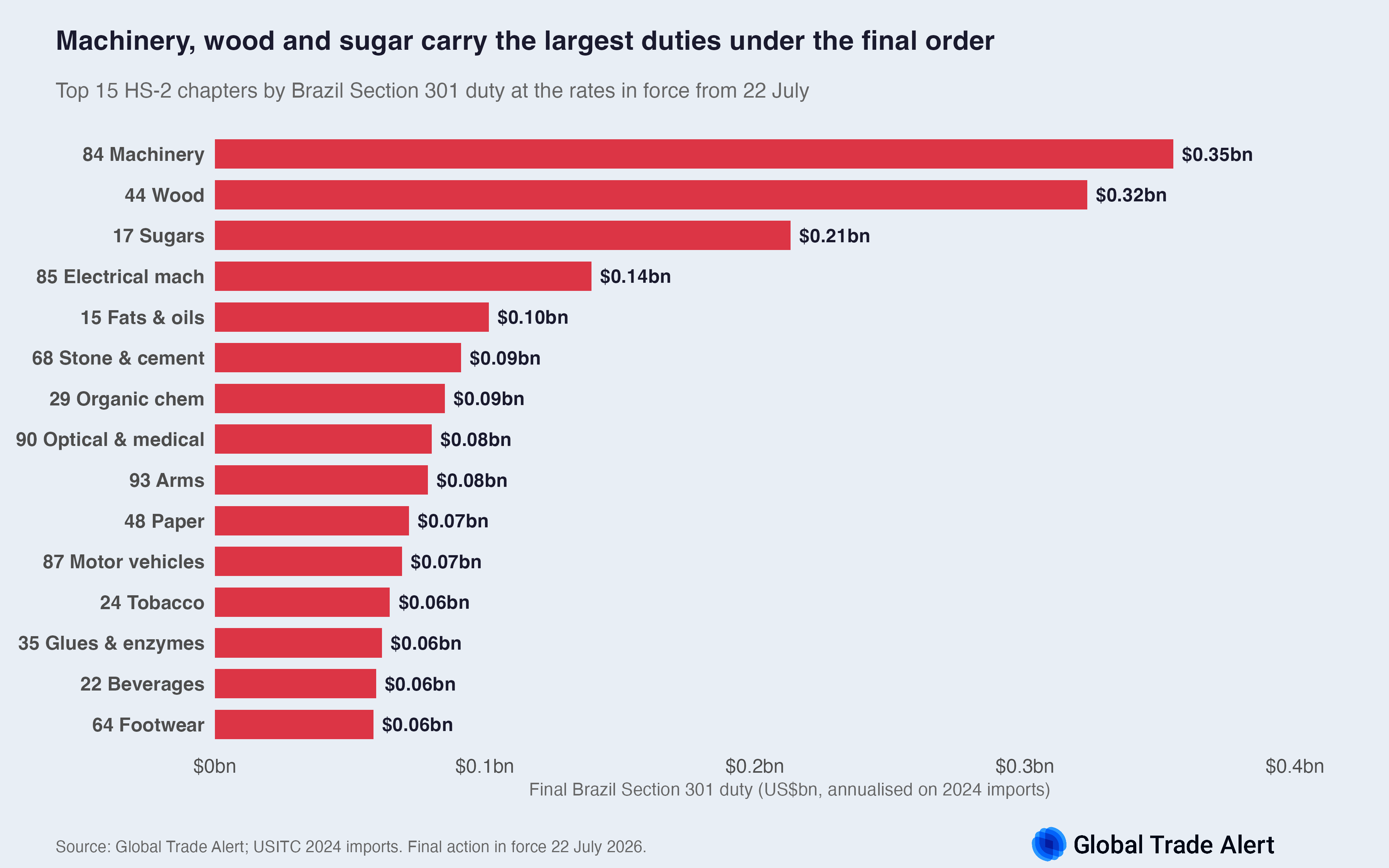
Because Section 232 goods sit outside the Section 301, the duty concentrates where earlier instruments do not reach. Machinery leads with $0.35bn of implied annual duty, followed by wood products ($0.32bn) and sugar ($0.21bn). Finished steel, Brazil's traditional flashpoint, contributes little: it already pays Section 232.
Downloads
- Brazil Section 301 final action dataset (headline figures, status transitions, product status and flow-level by HS-8)
- Charts and backing data (all charts plus per-chart spreadsheets)